Basketball Uniforms Materials – What is Used & Why

April 26th, 2013

Old Style, The Way Basketball Uniforms Were

When the sport began people played in the clothes they could spare. Many early era uniforms were made of wool. They had terrible combinations of articles and garments that seemed to be restrictive by design. It could not have been very comfortable to play basketball at this point in time. Imagine getting hot and sweaty inside of pants and long sleeve shirts, it happened! Believe it but who would instigate this kind of torture? At the time only natural fibers were available to make clothing from, so cotton and wool reigned supreme. Even though the textile industry was booming, man made fabrics had not yet been synthesized. Players would have to endure the less than ideal conditions in those initial years but hey, no pain, no gain. Aren’t you glad that you didn’t manage a gym back then?

Luckily by the 1920′s people got wise and started wearing shorts and a jersey style top. Movement was better and sweat could at last get off the skin with out total insulation, It was an improvement. After World War II synthetics were made available for every day commercial uses and soon found their way in to sporting uniforms. Further more, in this time machines began to be integrated in the garment making process like never before. Designs began to change rapidly. More skin got exposed as shorts got shorter as well as tighter, this trend also went for jerseys. Stylistically these new fabrics allowed for snappier looking designs. Before long it both the basketball players and the cheerleaders were wearing about the same amount of cloth. This kept up until much later in the century when the style reversed. Uniforms became bigger, they weren’t sitting against the skin at all times. These new changes were mostly player driven and not the result of technology or garment developments.

Modern Uniforms, What They Are Made Of and Why

The development of basketball uniforms over the years has seen many changes. They have been augmented significantly since the early days. Most notably are the materials that make up the garment itself. In fact, many changes are not only about the fabric but the over all style of uniforms that players wore on to the court. They have gone through a number of transitions through out the years. If you compare a picture of players from the early days of basketball to the present era you might even wonder if they are dressed to play the same sport. It that radical of a change over time!

In today’s uniforms we find state of the art fabric technology. Fully synthetic knits that are designed from the beginning to produce a superior look and feel. Plus they look really cool during high flying dunks. Fabrics such as Lycra and Dazzle are the standard in today’s sporting uniforms. They help moderate the body’s temperature better by getting sweat away from the skin or insulating against the environmental differences. Blends that incorporate a few different fibers are also popular. Nylon, polyester and even cotton still find regular use within the clothes that are currently worn by your favorite sports stars. Each fabric has benefits and applications that are unique, it is up to designers to great excellent products.

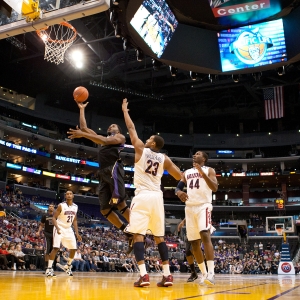
The loose fitting and flexible fabrics that make up today’s uniforms allow for a free range of motion. Basketball players move around a lot on the court. They must be able to position their arms and legs in any way that the moment requires. Not only for offense and defense but also self preservation. Basketball games are fast paced with huge people colliding on a daily basis. The athletes need to be able to control and maintain all the aspects of their performance and uniforms are a variable. We want them at their best so they should be dressed in the best.

Browse custom basketball uniform options here>>

Basketball Uniforms of The 1920′s – Design & Material

April 19th, 2013

Basketball uniforms of today are high tech marketing merchandise but this was not always the case. Before the garments in use today became the norm, vastly different uniforms were put into play by the first organized teams. In the 1920′s tailors and seamstresses did not have access to the same materials we do today. That is because they did not exist yet. They were forced to make due with what they could. Players also had to make due with what they had access to and in some cases it was not much. This article is an examination of the basketball uniforms worn by players in the early days of organized basketball, when it was still in its infancy and styles were wild.

The Way Things Were

Before the era of throwback basketball uniforms was: the real thing. Yes, its true. There have been some big changes in uniform development over the years but it all started in 1920′s when the game and what people wore was properly formalizing into what would become the practices and organizations we know today. The art of design is today respected highly, particularly in fashion circles. In the roaring 20′s style was beginning to blossom in clothing, architecture and automobiles. At this time materials were still stuck with sources from the natural world, meaning plants and animal based fabrics such as wool and cotton. Incredible advances were around the corner but nylon and polyester were not yet available for use.

This is the era that established Chuck Taylor’s popularity, we still see Converse shoes with his name on retail shelves today. It is also when jerseys buttoned under the crotch to secure them and ensure they would not come loose during the course of the game. Really, all the clothes were fairly form fitting. Baggy styles had not caught on yet.

It was also not uncommon to see children or women in knee pads, so as to protect their fragile legs. Get off the court if you can’t hang. Considering what everyone was wearing in earlier years, in terms of material and some of the crazier get ups, they might as well have been gladiators. The 1920′s had to be a blessing for basketball enthusiasts. Finally, everything was set and the sport could get some respect.

…And How It Is Now

Things have come a long way since the days of when uniforms were made of heavier material and fabrics like wool or cotton. These newer clothes are light to wear and help to get sweat off the players body. No one likes playing B-ball sweaty. Jerseys and shorts have a looser fit in the modern era. It is a result of style evolution as well as technology.

Comparatively, basketball uniforms of today require far less heavy maintenance, in laundering terms, and are far more durable and can handle the wear and tear as well as the wash cycle. That is because many use a modern fabric known as Dazzle. It is a type of polyester that has really caught on and can be seen in use by football and rugby players. It has even begun to find use in casual wear. Additionally, the material looks great. It is shiny and bright, you might even say dazzling! Whether you are sitting court side or taking in a game at home on your HD TV, the uniforms look sharp. The designs are awesome and the material really stands out. Thanks to those putting the schemes together they are visually interesting while keeping our favorite teams comfortable on the court.

Styles have changed dramatically over the years as people’s preferences have evolved but also as technology has come along and allowed for developments in the garment industry at large. There is no doubt the future holds new breakthroughs in that field and we will see it on the courts and fields of our favorite home teams.

How Basketball Uniforms Have Changed Over Time

March 25th, 2013

Have you ever looked at a basketball uniform and wondered how the style became what it is today? Or maybe you remember the old designs and just want to reminisce? Either way, read on because we are going to take a look at the evolution of the basketball uniform. From its early developmental days as a gymnasium sport to its current style inside the arenas of today. The general scheme has been the same, though alterations have lead to more fabric in some places with other regions losing coverage. This article will act as a compendium and guide to the biggest changes and trends in basketball uniforms through out the years the game has been played.

The Early Days of Sport

source: http://www.getkempt.com/this-sporting-life/the-basketball-uniform-an-evolution.php

source: http://www.getkempt.com/this-sporting-life/the-basketball-uniform-an-evolution.php

Who wants to run up and down a basketball court wearing a uniform that has grown sweaty from activity and is restrictive by the tailors orders, raise your hands? If you played basketball back in the late 1800′s around the turn of the century this is pretty close to the deal. Wool jerseys, trousers. Get in there, buddy. It is likely the sport would be far less popular in warm weather areas if things had continued this way for long, though it might have been a real contender for hockey’s supremacy in the cold weather countries.

A little later on things began to loosen up some. The introduction of shorts had to be a welcome presence in players locker rooms, though some still made due with pants. There are a few existing photos of teams posing in turtlenecks, if not playing in them, around the early 20th century.

Formative Years: A Proper Style Emerges

http://www.getkempt.com/this-sporting-life/the-basketball-uniform-an-evolution.php

http://www.getkempt.com/this-sporting-life/the-basketball-uniform-an-evolution.php

As basketball emerged from obscurity to popularity the rules and uniforms that players wore began to standardize. Organizations became more formal and regulated what was acceptable for those in the leagues to wear while playing. Savvy companies began to pluck talent from teams to endorse their products. One such product is still on the shelves today. The “Chuck Taylor” Converse All-star has been going strong since 1917 when he was on the team demonstrating the new sport around the country. These shoes have transcended the sport and have a sense of style to themselves. Wearers make a fashion statement just by wearing the shoes and being associated with the brand.

Short pants became the norm in this period. No more covering up. It seems during the 1920′s people wanted to get hot and bothered off the court. Can’t blame them, booze was illegal in that era due to prohibition. Through it all basketball was spreading. Leagues at all levels were sprouting across America. The NCAA organized its first national championship in 1938 and the NBA formed in 1946. Sleeveless jerseys and thigh high shorts became the norm.

Post-War Era: New Materials at Play

source: http://apbrbasketball.blogspot.com/2011/02/uniforms-of-70s.html

source: http://apbrbasketball.blogspot.com/2011/02/uniforms-of-70s.html

Technology that had been utilized for the war effort in the 1940′s soon found its way into other industrial purposes. Facilities that had been producing materials out of fabrics made of nylon or polyester began to convert their operations to peace time goods as the Baby Boomer population was exploding.

The nature of the game truly requires not only material that breathes but also ones that allow a full range of motion for the players. Uniforms began to get tighter and more form fitting reaching points that seem almost exhibitionist, should a person be at the wrong angle. Woe was the floor based photographer in this time period. Right on through the 1970′s and into 80′s short shorts kept creeping up the the players legs.

Reversal: Extending Uniform Coverage

source: http://www.pitt.edu/~mtb32/cs134/history.html

source: http://www.pitt.edu/~mtb32/cs134/history.html

The Michigan Wolverines players in the early 90′s known as the Fab Five, a group comprised of Jimmy King, Jalen Rose, Chris Webber, Ray Jackson and Juwan Howard popularized the style of wearing baggy shorts and black socks. The squad ended the season as the Runner Up in the NCAA Tournament in 1992 and 1993, pretty good run though the successes were later vacated by the Ed Martin scandal. In the NBA, baggy shorts began to catch on as well. Michael Jordan was one of the first at the level to mimic the style. This was a rungs lower than previous generations, as player’s gym shorts got longer and covered more of their thigh. These are the major trends you have seen since the 1990′s, more accessories, longer shorts, shorter socks.

Before long nearly everyone was wearing the baggy style and knees were seen no more. Things may have gone too far or perhaps David Stern and the league office just wanted to collect fines. They levied fines against a players like Jameer Nelson and Jamal Tinsley for the excessive length of their in game shorts during the the 2005 season.

Today, Uniforms Are Custom

924_samples_lgThe style of basketball uniforms has changed so much over the years, and new trends will continue to evolve. Today, you can order custom made basketball uniforms for your school team or recreational league. You can have your uniforms created exactly how you want them to create the exact look that you’re going for. They also need to be functional and comfortable while creating the look you want.

Accessorizing and Identity

source: http://www.celebritynetworth.com/richest-athletes/nba/allen-iverson-net-worth/

source: http://www.celebritynetworth.com/richest-athletes/nba/allen-iverson-net-worth/

This would not be a thorough document if it did not mention the many ways players accessorize their garments choices and supplement their style with equipment. There are photos of players wearing knee pads back in the 1920′s; the game must have been rough on the courts back then. Additional protective components have been utilized through out basketball’s history. Many players use arm sleeves such as Allen Iverson and Kobe Bryant, both of which were at times notable for their hair styles as well. Other players accessorize with a combination of sweat bands. LeBron James has been known to wear one on his head for most of his career.


NBA Twitter All-Stars: Followers vs Tweets [Infographic]

February 20th, 2013

Lots of people follow their favorite NBA team on twitter. We were curious just how many people are following NBA teams on twitter and how the teams stack up against each other with their twitter followings. So, we did some research and put all the data together into this really neat infographic. Feel free to use this infographic on your own site or blog. Just make sure to reference http://www.CiscoAthletic.com as the source!

A few important points to note:

  • There are 448,069 tweets from all the NBA teams on twitter
  • There is a total of 11,263,520 people following NBA teams on twitter
  • The Lakers is the most followed team on twitter
  • 26% of all people following NBA teams are following the Lakers
  • Less than 1% of people follow the Bobcats, the least followed team on twitter

In this infographic, you will see the top 5 most followed teams, and the top 5 teams that put out the most tweets. The interesting thing is that these 2 categories do not overlap at all. Just because you’re tweeting a lot doesn’t mean you will have the most followers!

The remaining 20 teams are at the bottom along with their tweet and followers stats. How does your team perform on twitter? Are they #BENCHED? Or are they #NBATWEETSTARS? Use those 2 hash-tags to join the conversation on twitter!

NBA Twitter All-Stars

Embed Code

<img src=”http://www.ciscoathletic.com/blog/wp-content/uploads/2013/02/nba-twitter-infographic.jpg”>Source: <a href=”http://www.ciscoathletic.com”>www.CiscoAthletic.com</a> | Get the embed code <a href=”http://www.ciscoathletic.com/blog/?p=144#embed”>here</a>.

Use the above code to easily add the infographic to your site or blog. Also feel free to save the image to your hard drive and share it anywhere. Just make sure to cite http://www.CiscoAthletic.com as the source!


Looking for team uniforms for your sports team?

Visit Cisco Athletic’s homepage to view all the sports we make custom team uniforms for.

High Protien Diet For a Wrestler

January 21st, 2013

Chicken Eggs

Wrestlers try to maintain a specific weight while remaining strong and agile. Because most wrestlers are trying to stay as skinny as possible, this means a highly controlled, low calorie, high protein diet. There are many things you can eat that follow within these guidelines.

Chicken

Chicken is a great source of protein that is low in fat and full of protein. It can be added to just about any meal or eaten by itself. A great option for a high protein diet, is to cook chicken breasts in your favorite season, by lightly searing them in a pan with a small amount of oil. This can be accompanied by a small salad full of veggies or on its own.

 Fish

Fish is great for wrestlers. Fish is naturally lean, and can be prepared many different ways. The shear number of options make this a popular choice. Fish is also high in heart healthy Omega-3 fatty acids.

Eggs

Drinking a raw egg before a match or before going out on a run is a classic, iconic image seen in movies and television shows for a long time now. To be safe, cook your eggs. Eggs provide the exact right balance of fat and protein for proper weight maintenance and muscle growth. Cooked eggs provide the same amount of nutrients, and have a lower risk of salmonella. Many people also find that cook eggs taste better and are easier to keep down.

Meat alternatives

Meat alternatives such as tofu and other soy products, tempeh, and seitan, as well as commercially prepared meat alternatives are all great for people who are vegetarians or are looking to cut the amount of meat in their diet. They can also be helpful for people concerned about the high cost of meat. Unfortunately not all meat alternatives are high in protein, so it is important to read nutrition labels before buying. Tofu, for example is often higher in fat, than other meat alternatives.

High Protein Grains

Some grains, like quinoa are very high in protein. These can help provide variety and form a more balanced, better tasting meal, than just eating meats, and meat alternatives. Other high protein grains include amaranth, and bulgar. All of these are easy to cook and can be served as an alternative to rice.

Red Meat

Red meat, while high in protein also, tends to be high in fat. While it is certainly a viable option, it is best to limit the amount of red meat eaten. When eating red meat, choose cuts that are low in fat, in order to stay lean and fit. There are many different kinds of red meat, some of which are leaner than others. Venison for example is a very lean meat, and while sometimes difficult to find is popular with dieters and athletes.

All of these options make for great choices and can help lend variety to a wrestler’s high protein diet. Remember that it is important to read nutritional labels, watch fat and carbohydrate intake, and to eat plenty of fresh fruits and vegetables to help balance out the diet.

Visit Cisco’s custom wrestling uniform section for more info on wrestling singlets and team uniforms today.

Volleyball Court Dimensions For All Levels of Play

December 31st, 2012

As in similar court-based sports, the rules of volleyball designate specific dimensions governing all aspects of the playing arena, from the area of the court itself to the height of the net at center court. These dimensions are laid out in the official rules established by volleyball’s governing body, the Fédération Internationale de Volleyball, or FIVB, which regularly updates and publishes these guidelines for competition.


According to the FIVB, the volleyball court surface must be a symmetrical rectangle, measuring 18 meters (59 feet) long and nine meters (29.5 feet) wide; thus, each side of the net is a nine-meter by nine-meter square. Additionally, there is a free zone, at least three meters wide, that surrounds the court on all sides. The net, which stretches across the center of the court, is raised to a level of 2.43 meters (seven feet, 11 5/8 inches) at its top for men’s competition and 2.24 meters (seven feet, four 1/8 inches) for women’s matches. Traditionally, a “free playing space,” free of all obstructions, exists between the court surface to a height of seven meters above the court surface; in FIVB World and Official competition, this space extends to 12.5 meters above the court surface.


Each side of the court is divided into two areas, and the lines demarcating these areas as well as the edges of the court are to be drawn 5 centimeters wide. On both sides of the net, there is a line stretching across the court at a distance of three meters from the net; this is called the “attack line,” and separates each side of court into “back court” and “front court” areas.


Although one might expect the dimensions of the volleyball court to be different at other levels of play, the specifications set forth by the FIVB also pertain to NCAA and high school competition courts. However, the sport of beach volleyball, which is a variation on the traditional game and became part of the Olympic Games in 1996, does have its own unique court dimensions whether it is played outdoors or on an indoor sand court. The beach volleyball court, which accommodates teams of two players to each side, is slightly larger than its traditional counterpart, measuring 16 meters (52 feet, six inches) long and eight meters (26 feet, three inches) wide.

Are you looking for custom volleyball uniforms for your team? Check out our volleyball page and see samples now!

College Wrestling Rules – A Guide For Beginners

November 29th, 2012

The goal of any form of wrestling for sport is to pin your opponent fully on his or her back. A pin is defined as the moment where your opponent is on his or her back. During an official pin, your opponent’s shoulders, shoulder blades, and back must touch the mat for at least two seconds. Once a pin occurs, the match is over. If there is no pin, the winner of the match is determined by the wrestler who scored the most points during the course of the match. This is the basic premise behind college wrestling rules.

Scoring

  • Take-down (2 points) – Two points are awarded when you take your opponent to the mat by clearly controlling him.
  • Escape (1 point) – A point is awarded for getting out of a hold or getting into a neutral position while your opponent is going for a pin.
  • Reversal (2 points) – Two points are awarded when you reverse a hold you are in when on the mat and turn it around so that you gain control.
  • Near Fall/Pin (back points) – Two or three points are awarded when an opponent is almost pinned. To be considered a near fall/pin, the following criteria must be met:


  1. Both shoulders must be held for at least 2 seconds within 4 inches of the mat.
  2. One shoulder touches the mat while the other remains at a 45 degree angle to the mat.
  3. One of the wrestlers is on both elbows or held in a high bridge.

A near pin lasting for two seconds is worth 2 points. A near pin that lasts for 5 seconds is worth 3 points.

  • Penalty Points (1/2 points) – Points are awarded to your opponent for the following rule violations:

Illegal holds or improper holds that the referee may call without warning. Holds determined to be “dangerous” also fall into this category, but may not involve a penalty.

Technical violations, which includes going off the mat at any point during the match, forcing your opponent off the mat, grabbing clothing or headgear, grabbing the mat for support, locked or overlapping hands, lack of proper or use of illegal equipment, unnecessary roughness, leaving the mat during the match without permission, stalling, unsportsmanlike conduct, false starts, incorrect starting position, and flagrant misconduct.

The first two offenses award a single point to your opponent. The third instance awards two points to your opponent. A fourth technical violation in a single game results in disqualification. The only exception is for a false start, which involves two warnings before any action is taken.

Note: Additional rules apply if a tie occurs when adding up points in a match where there is no pin. There are also rules that only apply during a tournament.

Breakdown of Volleyball Positions

October 28th, 2012

Volleyball positions determine the specific role of players during a game. On the court, each player works in his or her position with teammates to make the best possible plays.


Middle Blocker


Being an effective middle blocker requires agility and an ability to read the opponent’s setter. This player blocks the ball and must run quickly from one end of the court to the other. He or she also hits quick sets and is responsible for keeping the defense of the other team off balance.


Outside Hitter


A great all-around player, the outside hitter needs to be both a solid blocker and hitter. When the team is on offense, this player is a main passer and hitter. The player should also be able to work off the net and have excellent ball-handling skills.


Libero


A defensive specialist in indoor volleyball, the libero remains on the court at all times and is not limited by rotation rules. Good liberos are consistent, quick and have good ball-handling, digging and passing skills. During offensive play, the libero passes the ball well to set up a scoring hit. On defense, the libero digs the ball to keep play alive. This player also wears a different uniform than the rest of the team.


Setter


The backbone of the offense, the setter contacts the ball after a dig and delivers it to the team’s hitters. Good leadership and communications skills, ability to multi-task and consistency are important qualities of a setter.


Opposite


Playing opposite the setter, this player blocks the outside hitter of the opponent. The opposite must also cover the hitter if a set is not made and be prepared to dig. Opposite players must have good blocking and passing skills and quickly react to an oncoming hit.


The Rotation


Six players per team are on the court at one time. Each player begins in a specific location in two rows. During the game, every player except for the libero rotates to every location on the court, including both the back and front rows. While in the front row, players hit and block. Back row players provide digging and defense.


Players are rotated one clockwise spot each time the team gets possession of the serve or wins a side out. Players can change positions after the ball is served. If a player moves positions before the ball is served, the other team is rewarded a point.


The positions are given numbers, beginning with one in the lower right corner of the court. From left to right, numbers four, three and two are in the front row. The back row, from left to right, includes numbers five, six and one.

Cisco provides volleyball jerseys for teams across the country. If you’re in need of uniforms for your team, visit the volleyball jerseys page!

Volleyball Rules – Difference Between Indoor & Outdoor

October 24th, 2012

The following paragraphs describe the basic rules of volleyball as well is the differences between indoor and outdoor matches.


The dimensions of the indoor volleyball court are 29’6″ x 59′, the net height is generally eight feet and the ball weighs between nine and ten ounces. Beach volleyball courts are slightly smaller and the ball is larger and lighter. Indoor games have six players per side and outdoor games have two. Indoor players rotate, but outdoor players do not.


Play is started by the serve. The server stands behind the end line and hits the ball. The ball may be served either over handed or underhanded, but it must reach the opponents side of the net in order to be in play.


The other team may pass the ball up to three times before they send it back over the net. The same player may not hit the ball twice in a row. The goal of each team is to keep the ball in play, by keeping it in the air, while attempting to make the other team miss the ball so that it touches the ground. See our previous post on volleyball drills for practice ideas.


No part of a player’s body may touch the net. Players may not hold or throw the ball. Balls are passed with a bump, set or spike. A bump is passing the ball by hitting it with the forearms, a set is passing the ball by hitting it with the finger tips, and a spike is hitting the ball over the net after a set. A spike is often a downward hit aimed at making the ball hit the ground on the other team’s side so close to the net that the other team has no chance to save it. The other team may defend against a spike by using a block. A block does not count as one of the three passes for indoor volleyball, but it does for beach volleyball. Rules for setting and spiking are more stringent for beach volleyball.


Scoring is determined after every serve. If one side misses the ball or causes the ball to go out of bounds on the opposing side, the opposing side gets the point. The team winning the point also wins the next serve. If the ball lands on a boundary line, it is considered good.


Indoor volleyball is played in five set matches. The first team to reach twenty-five points, with a two point lead, wins the set. The team that wins three of the five sets, wins the match. Beach volleyball teams must take two of three sets with a winning score of 21 points per set.

Ready to play volleyball? Need uniforms for your team? Visit our volleyball jerseys and uniforms page to purchase volleyball jerseys for your team today!

Removing Sports Uniforms Stains How To

September 17th, 2012

Cisco is a leading manufacturer of US made custom sports uniforms. One thing we don’t exactly specialize in is cleaning uniforms, but it’s something that all of out customers have to know how to do. When dealing with different types of stains, it can often times be very hard to get certain spots out. Hopefully this infographic we created will help solve the problem of removing various stains in sports uniforms.

Get the embed code to put this on your blog here!

sports-uniforms-stains

Add this to your site / blog with the embed code below!